
Voice of the Danube
After setting the strategic direction on Day One, the 2026 Danube Water Forum (DWF) moves into implementation mode on Thursday, 21 May 2026. Where Wednesday framed why water resilience matters and where the Danube Region is heading, Day Two focuses on how resilience is built - asset by asset, process by process, and person by person.
For utilities, regulators, and partners across the region, the second day of the Forum offers a grounded, hands-on look at what it takes to translate policy ambition into reliable, climate‑ready water and wastewater services.
Build Smart - or Pay Later: Resilient Assets in Focus
The day begins where resilience visibly lives or fails: in physical infrastructure.
Chaired by IAWD's UMT coordinator Rado Rusev and Ognjen Govedarica (IWA Young Water Professionals Serbia), the opening session on Day Two takes a strategic yet highly practical look at asset management as a cornerstone of resilience. Rather than treating infrastructure as a static investment, the discussion frames assets as long‑term systems shaped by governance choices, materials, and digital maturity.
Through interactive roundtables, participants examine how ownership and and contractual modalities influence maintenance and renewal, how advances in materials science are extending asset lifespans, and how digital tools - from GIS and hydraulic models to digital twins - are transforming operational decision‑making. Contributions from utilities and solution providers illustrate how “building smart” today can prevent costly failures tomorrow.
Efficiency First: Making Every Drop Count
With climate variability increasing and investment resources under pressure, the late‑morning session turns to one of the most powerful - and immediately actionable - resilience levers: reducing non‑revenue water (NRW).
Chaired by Teodor Popa (IAWD Vice President) and Denisa Cadkova (IWA YWP Czech Republic), the session moves beyond analysis to focus on implementation and impact. Regional examples demonstrate how sustained NRW reduction programmes improve service reliability, strengthen financial performance, and postpone expensive new supply investments.
Utility experiences are complemented by technology insights, showing how planning, monitoring, leak detection, and customer engagement work best when applied together. The message echoes the Forum’s broader theme: resilience does not always require new infrastructure - often, it starts with using existing systems better.
Wastewater and Sludge: Resilience Below Ground
In the afternoon, attention shifts to parts of the system that are less visible, yet absolutely critical for public health and environmental protection.
Chaired by Adam Kovacs (ICPDR) and Sara Molnar (Danube Youth Council), the wastewater and sludge session tackles ongoing challenges across the Danube region - from incomplete sewerage coverage to the growing complexity of sludge management under climate and energy pressures.
Blending regional strategy with hands‑on experience, the session highlights nature‑based solutions, climate‑resilient wastewater treatment design, governance approaches to sludge, and innovative reuse concepts, including urban stormwater reuse. Together, the examples underline that resilient wastewater systems are not just about compliance - they are essential for long‑term water security and ecosystem protection.
From Infrastructure to People: Securing Skills and Talent
As the technical discussions conclude, the final session deliberately shifts perspective - because systems only perform as well as the people behind them.
Chaired by Elisabeta Poci (IAWD) and Jose Cordero (IWA YWP Switzerland), the session addresses one of the sector’s most pressing shared challenges: securing a skilled, motivated, and future‑ready workforce. With many utilities facing ageing staff, evolving technical demands, and competition for talent, the discussion explores how education providers, utilities, young professional networks, and private partners can work together to modernise career pathways.
Examples of youth engagement, intergenerational exchange, and new training models highlight that investing in people is not a “soft” issue - but a prerequisite for sustaining resilient water and wastewater services. The conversation also sets the stage for the leadership and partnership focus of Day Three.
Closing the Day - Together
The day concludes with the Conference Dinner at Laura Restaurant in Sofia’s National Palace of Culture. After a full day of technical exchange and practical insight, the evening offers space to connect across roles, countries, and generations.
More than a social moment, the dinner captures the spirit that has defined the Forum so far: learning together, sharing experience, and building resilience as a regional community.
From vision to systems, from assets to people - Day Two of the Danube Water Forum shows that resilience is built step by step, and always together. Registration for the Danube Water Forum remains open until 9 May. There is still time to be part of the conversation shaping the future of water resilience in the Danube region. Secure your place, we are looking forward to seeing you in Sofia!
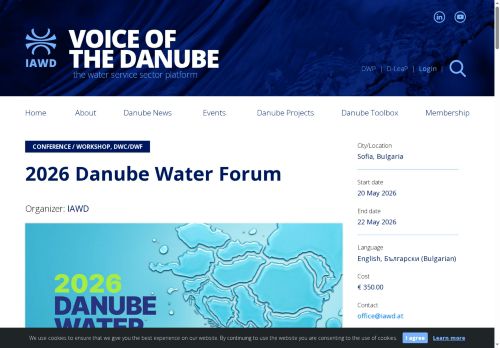
VoD - 2026 Danube Water Forum
The 2026 Danube Water Forum From Vision to Action: Building a Water-Resilient Danube Region will convene from 20 to 22 May, 2026 in Sofia, Bulgaria, back to back with business meetings as well as the annual UBP Danube Hub w...